
Perci vs. Helium 10
Perci vs. Helium 10: they solve different problems
Last checked: August 2026
Most of our customers pay for both.
Helium 10 is a suite: product research, keyword tools, advertising, rank tracking, analytics, and operations. Perci specializes in producing listing content in bulk, including the backend attributes most listing tools do not address. If you are choosing between them, you may be comparing two tools that are not substitutes.
Here is the honest split.
Section 1
What Helium 10 does that Perci doesn't
Perci does not compete with these jobs, and does not try to:
- Product research: Black Box, Xray, and Product Launchpad help sellers evaluate products and opportunities.
- Advertising: Helium 10 Ads supports Amazon PPC analysis and campaign automation.
- Operations: Inventory Manager, Refund Genie, Alerts, and Follow-Up cover ongoing seller operations.
- Profit and market analytics: Profits, Market Tracker, Market Tracker 360, and Keyword Tracker monitor performance over time.
Helium 10 also includes keyword research and listing tools such as Cerebro, Magnet, Listing Builder, and Listing Analyzer. Those are the areas where the products overlap. If you need the broader research, advertising, operations, or analytics stack, Perci will not replace it, and this page is not going to argue that it should.
| Seller job | Helium 10Broader seller suite | PerciListing production |
|---|---|---|
| Product research | Black Box · Xray | Not offered |
| Keyword research | Cerebro · Magnet | Built into listing workflow |
| Listing copy | Listing Builder | Generated in bulk |
| Category attributes | Not documented | Completed in bulk |
| PPC advertising | Helium 10 Ads | Not offered |
| Keyword rank tracking | Keyword Tracker | Rank tracking |
| Profit analytics | Profits · Market Tracker | Not offered |
| Inventory & refunds | Inventory Manager · Refund Genie | Not offered |
Section 2
Where Perci does something Helium 10's listing tools don't
Category attributes across a catalog
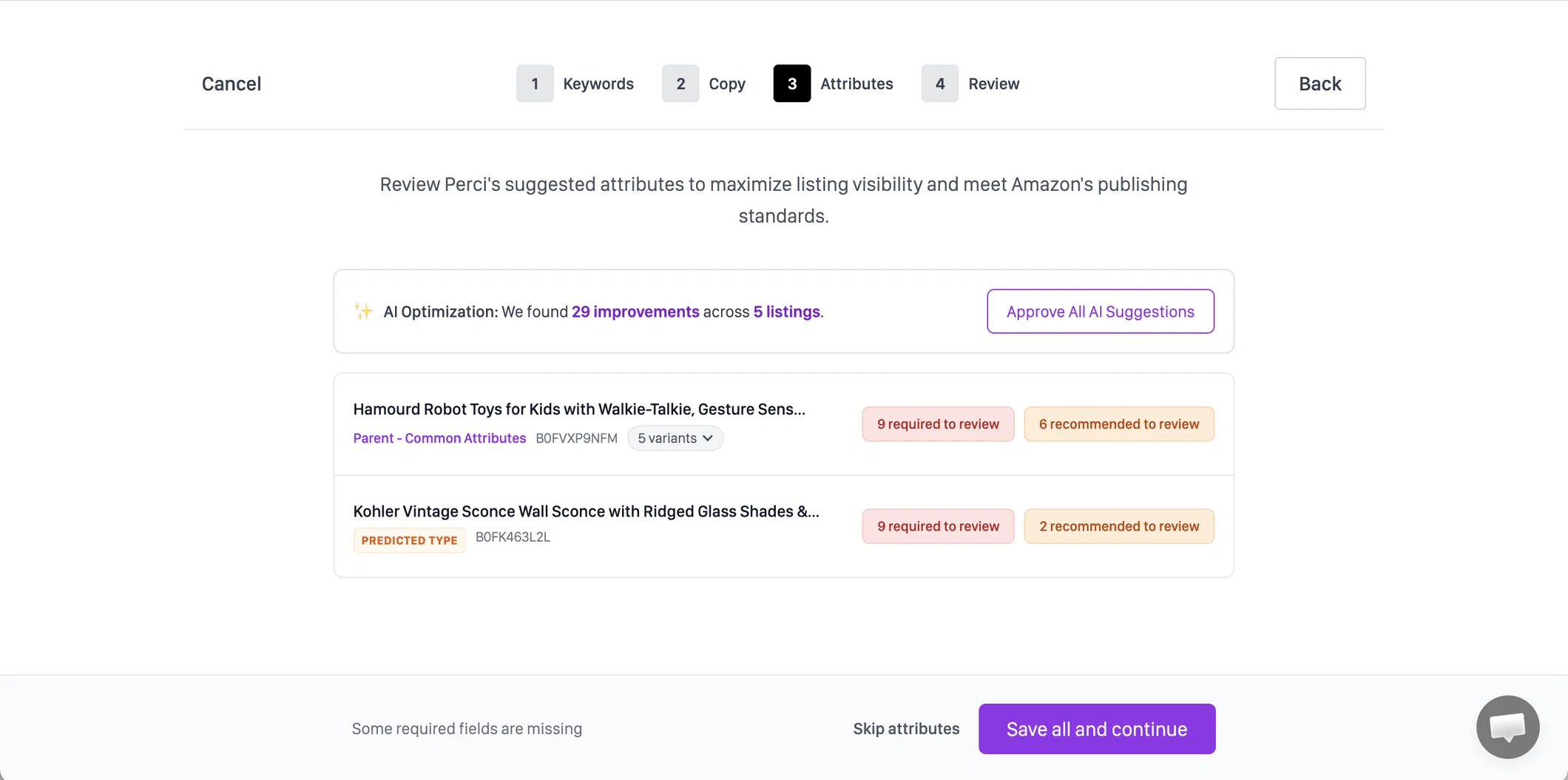
Perci reads each listing's product type, suggests values for the recommended attributes Amazon requests, and publishes approved values back across a catalog. Helium 10's public listing workflow emphasizes copy, keywords, A+ content, and listing analysis rather than category-specific attribute completion at this scale.
Variation families handled together
Parents and children stay consistent where they should and differ where they should, across the entire family rather than as disconnected listings.
Publishing with confirmation
Approved listings go to Amazon through the API, and Perci confirms that the change landed on the product detail page.
Volume as the default
One team has processed 10,046 listings through Perci. Bulk is not a separate mode; it is the assumption the product is built around.
Section 3
Where it's genuinely close
For a single listing, Helium 10's writer may be all you need. If you are optimizing one product and already have your keywords, the gap between the tools is small. Perci's advantages compound with volume; at a volume of one, most of them do not apply.
Section 4
Which one you actually need
Use Helium 10, without Perci, if:
- You need product research, advertising, operations, or analytics.
- Your catalog is small enough to write by hand.
- You optimize only a handful of listings each quarter.
Use Perci, and keep Helium 10, if:
- Listing work arrives in batches your team cannot write by hand.
- Your content quality scores are low and you do not know why.
- You are expanding a catalog into new marketplaces.
- You need attributes completed across hundreds or thousands of ASINs.
Replace Helium 10 with Perci only if:
- Keyword research and listing content are the only Helium 10 tools you use.
- You do not use it for product research, advertising, operations, or analytics.
Some customers came from exactly this position: they were paying for a suite and using two corners of it. Perci covers those two corners. If you open Helium 10 for anything else in a normal month, keep it.
Use neither if:
- You have fewer than 10 listings and enough time to manage them yourself. Both tools can be overhead at that size.
Section 5
What it costs
Perci is credit-based: one credit per listing, no subscription, and credits do not expire. You can buy capacity for a catalog project and leave it idle until the next project without an ongoing software charge.
Helium 10 sells recurring subscriptions to a suite of tools designed for continuous use. The exact tools and usage limits depend on the plan, and Helium 10 changes packaging over time, so check its current plan page before buying.
That is the structural difference, and it is why the tools can coexist comfortably: one is a standing suite for ongoing seller work; the other is capacity you buy when a pile of listings lands.
Section 6
Frequently asked questions
Should I cancel Helium 10 if I get Perci?
Probably not. Most of our customers run both: Helium 10 or a similar suite for research, advertising, and monitoring, and Perci for producing and publishing listing content at volume. If keyword research and listing content are the only parts of Helium 10 you use, Perci may replace that narrower workflow.
Can Helium 10 complete backend attributes in bulk?
Helium 10's current public Listing Builder materials focus on titles, bullet points, descriptions, A+ content, and backend keywords. They do not document the category-specific recommended-attribute completion and catalog publishing workflow described on this page.
Which writes better copy?
It depends on the listing and who is judging. For one listing with keywords already in hand, the practical difference may be small. Across hundreds of listings, consistency, variation handling, attribute completeness, and publishing workflow matter more than any single piece of copy.
Do Perci and Helium 10 integrate?
There is no direct integration. You can move listing data between the tools with spreadsheet exports and uploads: export from Perci for use in Helium 10, or export from Helium 10 and upload the file to Perci.