
Perci resources · Blog
Keyword research with AI: how to do it right on Amazon
Last updated: August 30, 2026
AI keyword research for Amazon is using AI to automate the keyword research pipeline: finding the terms shoppers search, scoring them against your product, ranking them by value, and merging them into one complete list. The AI does the heavy lifting across sources and at scale; you review and choose.
I will show you step by step how you can do AI-powered keyword research, so you can run it yourself, evaluate any tool that claims to do it, and know what "good" looks like.
The trap: AI hallucinates keywords
A language model has no way to look up what shoppers actually search on Amazon. So when you ask it to "generate keywords for a coffee mug," it does the only thing it can: it makes up plausible-sounding terms and states them confidently, with no way to know which ones are real.
We tested this. Asked to generate keywords for a wireless gaming mouse, ChatGPT produced 36 terms, and 25 of them had zero U.S. Amazon search volume. The list was roughly 31% real, and nothing in the output identified which 31%. See the full ChatGPT comparison →
That is not keyword research. It is the most common way sellers try "AI keyword research" and get burned.
You need hard data sources: AI keyword research is only as good as the data pipeline behind it. If the AI is generating keywords from nothing, you get confident guesses. If the AI is automating a pipeline around real Amazon search data like SQP reports or reverse-ASIN data, you get a ranked list grounded in what shoppers actually search.
The method
Here is the step-by-step approach Perci runs for keyword research.
Step 1: Root keywords and competitor ASINs
What this is: Keyword research starts with seeds: the root keywords for your product (the obvious terms shoppers use), and the competitor ASINs whose keyword footprints you want to mine. Everything downstream depends on these inputs.
How to do it yourself:Root keywords are the easy part: you brainstorm the obvious terms for your product ("coffee mug", "travel mug"). Competitor ASINs are harder. The manual method:
- Search Amazon for your main root keyword.
- Look at the top 5 to 10 organic results (and the "Amazon's Choice" picks).
- Note the ASINs of the listings that look like your product, not just the best sellers.
- Repeat for each of your root keywords, and dedupe the ASINs by hand.
The judgment call is the hard part: which of the top results are actually competitors worth learning from, versus best sellers in a different niche that happen to rank for the same word? Get this wrong and you mine the wrong listings.
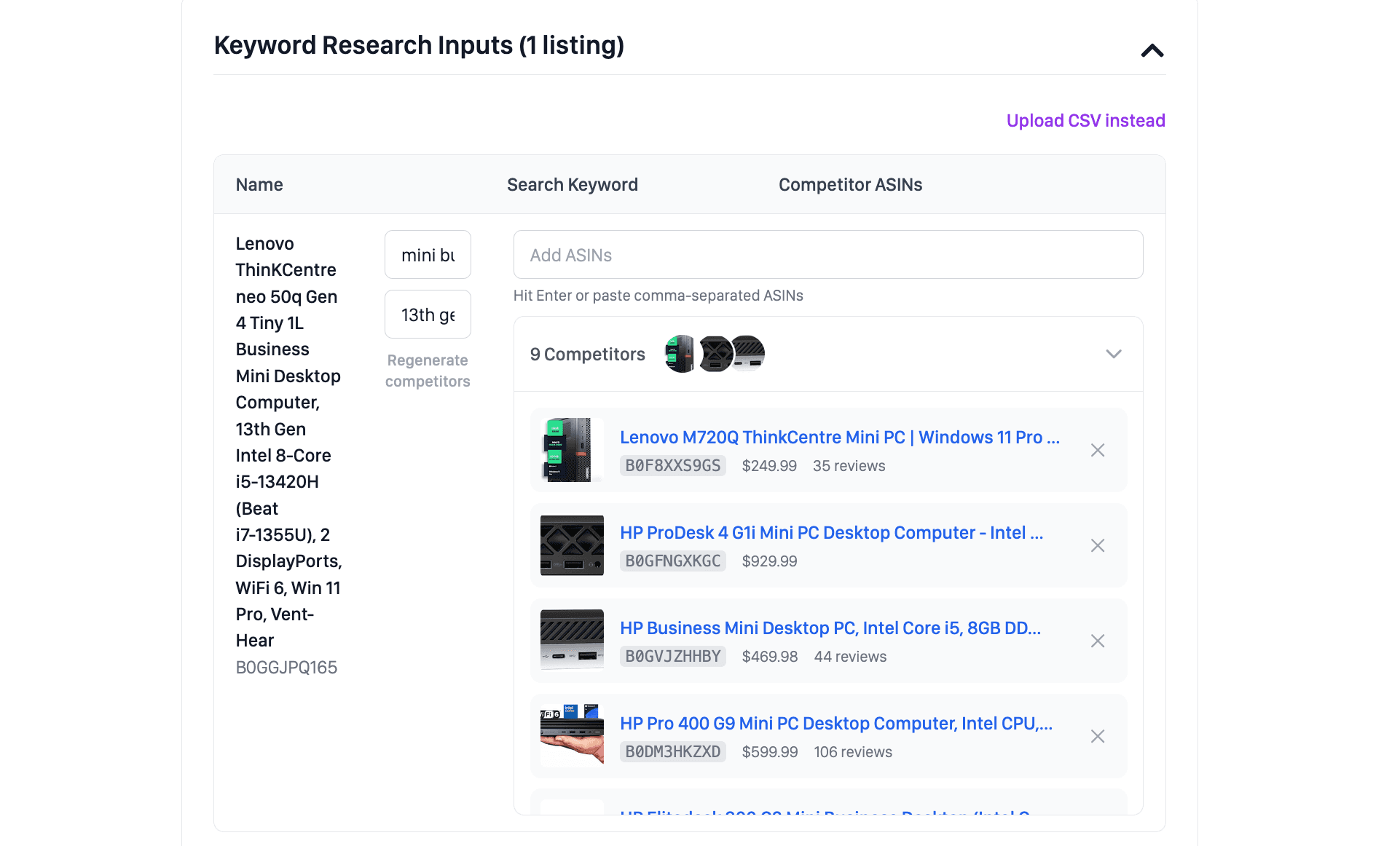
How Perci does it:Perci can auto-detect your competitors. Given your product name and description, it generates root keywords, searches Amazon for each one, collects the organic results and Amazon's Choice picks, excludes listings from your own brand, then ranks the candidates by how similar they are to your product (using embeddings, not just position) and returns the top competitors. You get the right ASINs to mine, without hunting for them.
Step 2: Pull keyword data from all the sources
What this step is: Once you have root keywords and competitor ASINs, you pull raw keywords: the search terms each source tracks for those inputs, with volume and impression data. This is where the raw candidate pool comes from.
How you do it yourself: You run each root keyword and each competitor ASIN through a keyword tool (Helium 10, Jungle Scout, DataDive, SellerSprite) and export the results.
How Perci does it: Perci runs your root keywords and competitor ASINs through multiple Amazon keyword data sources at once, pulling the search terms each source tracks, with volume and impression data.
Step 3: Combine and dedupe
What this step is: The results from every source overlap. The same keyword appears in multiple exports with different volume estimates. You merge everything into one list, combining the duplicates into a single row.
How you do it yourself: A spreadsheet. You paste the exports together, dedupe by phrase, and average the volume columns.
How Perci does it: Perci merges the results from all sources into one list, with duplicate phrases averaged and combined.
Step 4: Filter the noise
What this step is: The combined list is full of junk: keywords with negligible search volume, competitor brand names, misspellings, foreign-language terms, and irrelevant or nonsensical phrases. Filtering removes what is not worth acting on.
How you do it yourself: Two passes. First, a volume filter: drop the terms with negligible search activity so you are not scrolling through thousands of one-impression rows. Second, a judgment pass: scan for competitor brands, misspellings, foreign terms, and irrelevant phrases, and remove them. The second pass is slow and error-prone by hand, and it is exactly where AI helps.
How Perci does it: Perci filters in two stages. First, keywords with negligible search volume drop out automatically. Second, AI detection passes remove the rest: competitor brand names, misspellings, foreign-language terms, irrelevant keywords, factually incorrect ones, and ungrammatical phrases. The misspellings and foreign terms aren't deleted; Perci saves them for the backend search terms field, where they still capture traffic without cluttering your visible copy.
Step 5: Score relevance against your product
What this step is: Volume is not fit. A keyword can have huge search volume and be completely irrelevant to your product. Relevance scoring measures how well each keyword matches your specific product, so the list is ranked by fit, not just popularity.
How you do it yourself:This is the step you cannot really do by hand at scale. Reading 2,000 keywords and judging each one against your product is hours of work, and your judgment drifts as you go. You can ask an AI to help, but a plain "is this relevant?" prompt gives you inconsistent answers with no way to rank them.
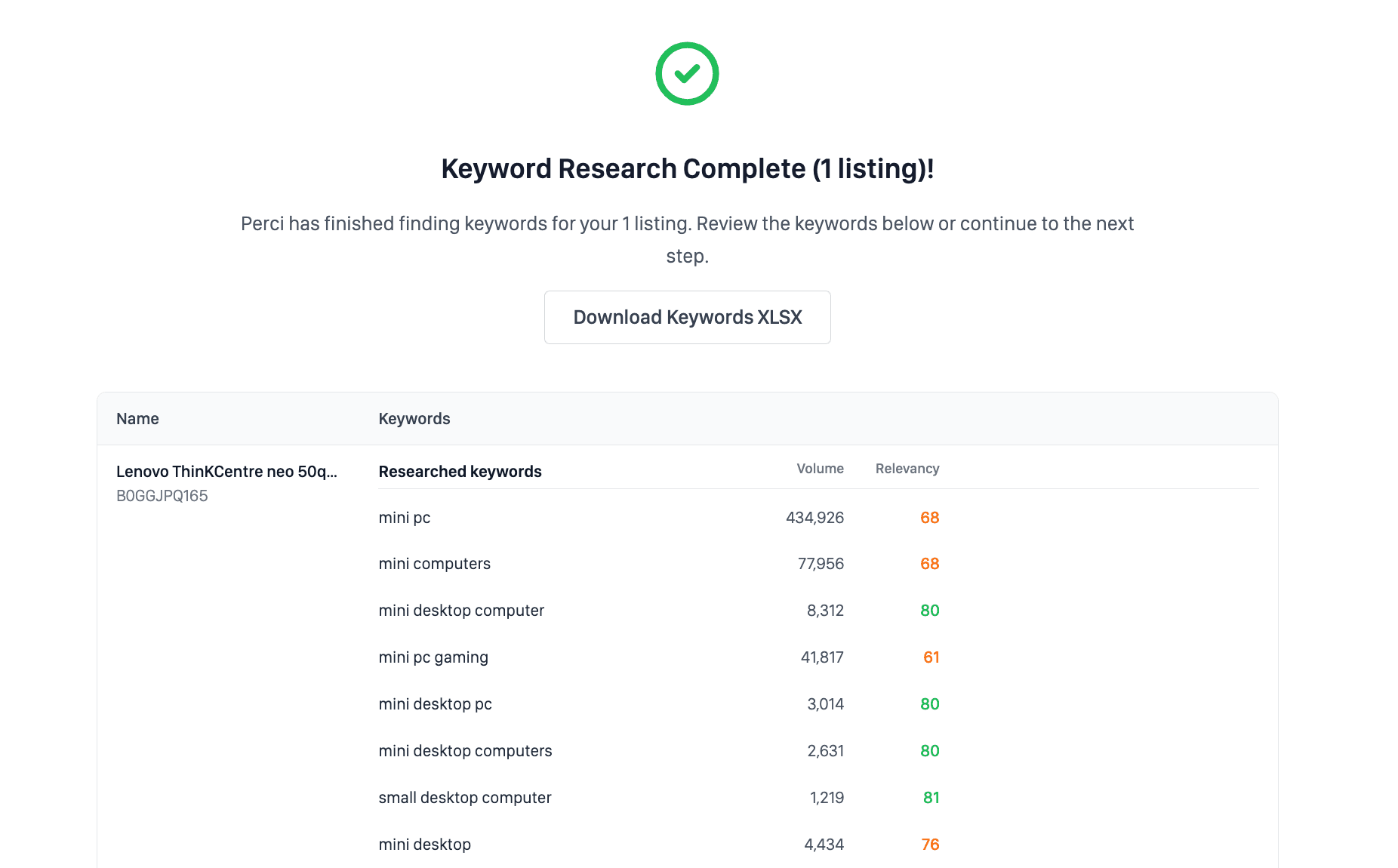
How Perci does it:Perci scores each keyword against your product's name and description using embeddings and semantic matching. Every keyword gets a relevance score, so the list separates "people search this" from "people search this and would buy yours."
Step 6: Rank by value
What this step is: With relevance scored, you rank the keywords by a composite of volume, relevance, and competitive position, so the keywords worth targeting first are at the top.
How you do it yourself: You sort the spreadsheet by your best guess at value and eyeball the top of the list. It works for a handful of keywords; it does not scale.
How Perci does it: Perci ranks the relevant keywords by a composite score and sorts them into strategy views (relevant search, keyword opportunities, competitor gaps, long tail, and more), so you can look at the list the way that fits your goal.
Step 7: Merge in your SQP data
What this step is: Keyword research discovers terms you should target. Your Search Query Performance data shows the terms shoppers already use to find your listings, with proven revenue and opportunity types (visibility, click, and purchase gaps). Merging the two gives you a complete list: discovered keywords plus proven keywords. Our SQP analysis method →
How you do it yourself: You export your SQP report, match the terms against your keyword research list by hand, and try to reconcile two different datasets in a spreadsheet. It is doable for one listing and painful for a catalog.
How Perci does it: Perci merges your SQP keywords into the keyword research results and re-scores relevance across the combined set, so the final list combines discovered keywords (from research) with proven keywords (from your own performance data) in one ranked view.
Doing it yourself vs. using a tool
You can run this pipeline yourself. It is manual, multi-tool, and spreadsheet-heavy, but it works for a handful of listings. The steps that hurt most by hand are the ones AI automates best: competitor detection (Step 1), noise filtering (Step 4), and relevance scoring (Step 5). The manual version collapses at catalog scale, where every listing starts the process over and the spreadsheet work multiplies.
How Perci does it (the whole thing)
Perci runs the entire pipeline above for you, per listing, across your catalog:
- Root keywords and competitor ASINs, with auto-detection of competitors from your product name and description.
- Multi-source keyword pulls, combined and deduped into one list.
- Noise filtering, including competitor brands, misspellings, foreign terms, and irrelevant phrases, with misspellings and foreign terms saved for the backend field.
- Relevance scoring against your product's name and description, so the list is ranked by fit, not just volume.
- SQP merge, so the final list combines discovered keywords with the proven keywords from your own performance data.
- One workflow: the keywords you select flow straight into the listing, title, bullets, description, and backend search terms. The research and the writing are one workflow, not two projects.
You review and choose; the pipeline does the rest.
Frequently asked questions
Does AI keyword research work for Amazon?
Yes, when the AI automates a pipeline around real Amazon search data. It does not work when the AI is asked to generate keywords from nothing, because a language model cannot know what shoppers actually search.
What is the difference between AI keyword research and asking ChatGPT for keywords?
ChatGPT generates plausible-sounding keywords with no search-volume data behind them. AI keyword research automates the pipeline: pulling real keyword data from multiple sources, scoring relevance against your product, ranking by value, and merging your SQP data.
What inputs do I need to start?
Root keywords for your product, or your own ASIN. Perci can also auto-detect your competitors from your product name and description, so you do not have to find them yourself.
How does Perci find competitor ASINs?
It generates root keywords from your product name and description, searches Amazon for each one, collects the organic results and Amazon's Choice picks, excludes your own brand, then ranks the candidates by similarity to your product using embeddings and returns the top competitors.
How does Perci score keyword relevance?
Each keyword is scored against your product's name and description using embeddings and semantic matching. A keyword can have huge volume and be irrelevant to your product; relevance scoring separates 'people search this' from 'people search this and would buy yours.'
What happens to misspellings and foreign keywords?
Perci detects them during filtering and saves them for the backend search terms field instead of deleting them, so they still capture traffic without cluttering your visible copy.
How does SQP data fit into keyword research?
SQP shows the keywords shoppers already use to find your listings, with proven revenue and opportunity types. Perci merges SQP data into the keyword research results, so the final list combines discovered keywords (from research) with proven keywords (from your own performance data).
Can Perci do keyword research for a whole catalog?
Yes. The pipeline runs per listing across your catalog, so root keywords, competitor mining, relevance scoring, and SQP merge happen for every listing at once, not one at a time.