
Perci resources · Blog
Amazon backend keywords: how to find and optimize the search terms field
Last updated: August 29, 2026
The backend search terms field in Seller Central gives you 250 bytes of hidden search relevance. Here is how Amazon actually weights it, what belongs inside, and why repeating your title keywords hurts you.
What are Amazon backend keywords?
Amazon backend keywords (officially the "Generic Keyword" or "Search Terms" field) are a hidden keyword field in Seller Central that shoppers never see but Amazon's search engine indexes. They sit in the backend of your listing, alongside your title, bullets, and description, and they help Amazon match your product to search queries.
The field is limited to 250 bytes for most categories (not 250 characters, which matters more than most sellers realize). Every word you put there is invisible to shoppers but searchable by Amazon. It is one of the few places you can add keywords without cluttering your visible listing copy.
How Amazon weights your keyword fields
Not all keyword placement is equal. Amazon's search engine weights your listing's fields in a clear order:
The title is the highest-weight field. Bullets and description follow. The backend search terms field carries the least weight of all four. That ordering drives everything about how you should use the backend field, and it is the reason for the core rules below.
Rule 1: The backend is overflow, not a second title
Because the backend field has the lowest weight, it is not where your most important keywords belong. Your best keywords should live in the title, then bullets, then description, in that order. The backend field exists for what is left over:
- Keywords you do not have space for in the title, bullets, or description.
- Keywords that are not good shopper-facing words: misspellings, foreign-language terms, and other terms that would look wrong or spammy in visible copy.
That is the mental model: the front end of your listing is prime real estate for the keywords that matter most. The backend is the overflow tank for everything else that is still relevant but does not deserve (or cannot fit in) front-end placement.
Rule 2: Backend keywords are single words, not phrases
This is the rule most guides get wrong. The backend search terms field is not phrase-based. It is a list of single, individual words.
A phrase like "kids fishing net for pool" is four separate words: kids, fishing, net, pool. Amazon indexes each word independently and matches them against search queries. You do not need to write full phrases in the backend; you write a list of unique, relevant single words, separated by spaces.
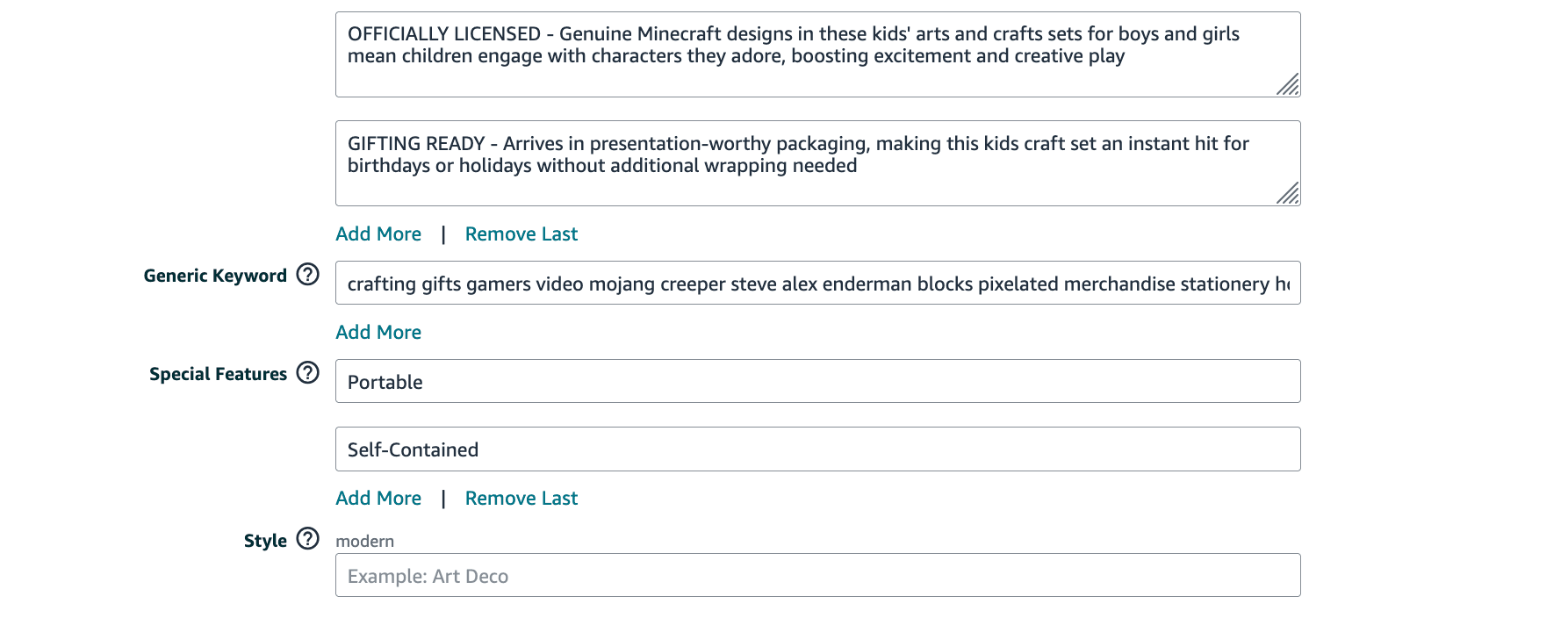
This changes how you fill the field. Instead of thinking "what phrases should I target," you think "what individual words are relevant to this product that are not already in my visible copy."
Rule 3: Do not repeat front-end keywords in the backend
There is an ongoing debate about whether to repeat your top keywords in the backend field. Our advice: do not do it, and this is specifically about individual words.
Here is the reasoning. Amazon's algorithm is not transparent about where it "marks" a keyword as indexed in your listing. If you have an important keyword in your title and you repeat it in the backend, Amazon may mark that keyword as a backend keyword rather than a title keyword. Since the title carries much more weight than the backend, you risk downgrading the placement of your most important keyword.
The safe rule: if a word is already in your title, bullets, or description, do not repeat it in the backend. Use the backend for new words only. Every byte you spend repeating a front-end keyword is a byte you could spend on a word Amazon has not seen yet.
The 250-byte limit (and why it is not 250 characters)
The single most misunderstood rule about backend keywords is the limit. It is 250 bytes, not 250 characters. A byte is the unit of digital storage, and not every character takes one byte:
| Character type | Bytes per character | Example |
|---|---|---|
| Standard letters / numbers | 1 byte | a, b, c, 1, 2, 3 |
| Accented characters | 2 bytes | é, ü, ñ |
| Emoji / special symbols | 3 to 4 bytes | 🎁, ✓, £ |
For example, "café" takes 5 bytes in UTF-8 (c-a-f-é, where é takes 2 bytes), not 4. A field full of accented characters or symbols fills up faster than one with plain text. If you exceed 250 bytes, Amazon truncates the excess, and the truncated keywords simply do not index.
The practical rule: use plain ASCII text, no commas, no symbols, no emoji. Every byte counts.
What to put in (and what to leave out)
The best backend keywords are single words that are relevant, searchable, and not already in your visible copy:
- Synonyms shoppers might use ("net", "catcher", "scoop")
- Use-case words ("pool", "beach", "pond", "garden")
- Audience words ("kids", "children", "toddler")
- Misspellings of high-value terms (see note below)
- Foreign-language equivalents if you sell internationally
What Amazon policy explicitly forbids:
| Do not include | Why | Example |
|---|---|---|
| Your own brand name | Already indexed via your title; wastes bytes | D.A.Y. Republic |
| Competitor brand names | Against Amazon policy; can get listings suppressed | Helium 10 |
| Other products' names | Misleading; Amazon treats it as keyword stuffing | Nintendo Switch on a mug listing |
| ASINs | Not searchable terms; Amazon explicitly forbids | B0H2FJH1L7 |
| Subjective claims | Overused words like best, cheapest, number one | best mug ever |
| Seasonal / irrelevant terms | Wastes bytes and can hurt relevance | christmas on a year-round product |
| Commas or punctuation | Unnecessary; spaces separate words | mug, cup, glass |
| Words in visible copy | Risk of downgrading placement (see Rule 3) | fishing if it is in your title |
Misspellings and foreign terms: the practical approach
Amazon's official guidelines say not to include misspellings. In practice, there is a real tradeoff, and this is exactly the kind of term the backend field is suited for:
- Misspellings ("fishing nett", "butterfly nett") can capture traffic from shoppers who typo their searches. They are not good shopper-facing words, so they do not belong in your title or bullets. The backend is where they go. Amazon's policy discourages them, but many sellers include a few high-value ones.
- Foreign-language terms work the same way for international marketplaces. If you sell in the UK and Germany, relevant German search terms in the backend can help you show up for German queries without cluttering your English copy.
The safest approach: include a small number of high-value misspellings and foreign terms, and never stuff the field with them.
How to find backend keywords for your listing
You do not guess backend keywords. You find them from data:
- Mine your SQP report. Your Search Query Performance report shows the exact terms shoppers used to find your listings. The converting terms not in your visible copy are prime backend keyword candidates.
- Check competitors' visible keywords. Look at top-ranking listings for your terms. What words do they use that you do not?
- Use keyword tools for discovery. Use AI keyword research or traditional tools to find relevant search terms and ideas you had not thought of.
- Draft, dedupe, and count bytes. Write your candidate list as single words, remove anything already in your title or bullets, and verify the byte count.
Then track your rankings to see whether the backend keywords you added actually move your positions. The backend field is where hidden keywords go; rank tracking is how you know they are working.
How Perci handles backend keywords
Perci fills the backend search terms field as part of its automated listing workflow, using these exact rules:
- Front-end first. Perci places the highest-value keywords in the title, bullets, and description first, because those fields carry the highest weight.
- Backend as overflow. Keywords that do not fit in the front end, or that are not good shopper-facing words, flow into the backend field.
- Single words, deduped. Perci generates unique single words and excludes any word already present in your listing's visible copy, so nothing gets repeated and downgraded.
- Misspellings and foreign terms demoted. When Perci's SQP analysis detects misspellings or foreign-language terms, it saves them for the backend field rather than deleting them or putting them in visible copy.
- Byte-accurate. Perci fills the field up to the 250-byte limit without cutting words in half, stripping special characters and overused words automatically.
Frequently asked questions
What is the Amazon backend keywords field?
It is the hidden Generic Keyword (Search Terms) field in Seller Central. Shoppers never see it, but Amazon's search engine indexes it to help match your product to search queries.
How many characters can I use in Amazon backend keywords?
The limit is 250 bytes, not 250 characters. Standard letters take 1 byte each, accented characters take 2, and symbols or emoji take 3 to 4. Plain ASCII text maximizes what fits.
Are backend keywords phrases or single words?
Single words. The backend field is a list of unique, individual words separated by spaces, not phrases. Amazon indexes each word independently.
Should I repeat keywords from my title in the backend field?
No. Amazon's algorithm is not transparent about where it marks a keyword as indexed. Repeating a title keyword in the backend risks Amazon marking it as a backend keyword instead of a title keyword, downgrading its placement. Use the backend for new words only.
Do I need commas between backend keywords?
No. Spaces separate words. Commas and other punctuation just waste bytes.
Can I include competitor brand names in backend keywords?
No. Amazon's policy forbids competitor brand names and other products' names. It can get your listing suppressed.
Should I include misspellings in backend keywords?
Amazon's official guidance says no, but misspellings are exactly the kind of non-shopper-facing word the backend field is for. Many sellers include a few high-value ones to capture typo traffic. Keep it to a small number and never stuff the field.
How do I find good backend keywords?
Mine your SQP report for converting terms not in your visible copy, check competitors' keywords, and use a keyword tool for discovery. Validate everything against your own data.
Can Perci fill in my backend keywords?
Yes. Perci fills the backend field automatically: front-end keywords go to the title, bullets, and description first, and the overflow (including misspellings and foreign terms from SQP analysis) goes to the backend as unique single words, within the byte limit.