
Perci resources · Blog
Amazon rank tracking: why it matters, what to track, and how to pick tools
Last updated: August 29, 2026
Amazon gives you impressions, clicks, and conversions. It never tells you your organic position, the number that decides whether any of the rest happens. Here is how rank tracking works and what to do with it.
What is Amazon rank tracking?
Amazon rank tracking is the practice of recording your listing's organic position for specific keywords over time. Each check captures where your product sits in Amazon search results for a given search term, and the history builds a picture of whether you are gaining, holding, or losing ground.
It answers the question Amazon's own reports never will: where do I rank, and is it getting better or worse?
A note on organic rank: it is directional, not exact
Organic rank is often discussed as a single number. In reality, organic position is highly variable and changes with timing and location. The same listing could show up at spot 1 on Tuesday and spot 8 on Friday, depending on when and where the search happens.
This does not mean tracking organic rank is meaningless. It means tracking rank is directional. As long as you track it in a consistent way, you can read changes up and down. You can tell if you have begun indexing for a new keyword, and you can tell if you have grown for a query from the 50s to the 20s to the 10s. The exact position on any given day matters less than the trend over time.
That is why consistency matters more than precision: the same tool, the same keywords, the same cadence, week after week. The noise averages out, and the signal is the direction.
The number Amazon hides from you
Amazon gives you a lot of data, and none of it includes your organic position.
- Search Query Performance (SQP) shows what shoppers searched, how many impressions your listing earned, how many clicked, and how many bought. It compares your share of the query against the category.
- Sales and traffic reports show sessions, units, and conversion rates.
- Business reports show sales and traffic by SKU.
None of them tell you the position you held when that impression happened. You might get 10,000 impressions for a keyword from ranking eighth, or from ranking first. The report treats both as 10,000 impressions. Position is the variable that determines everything else, and Amazon does not hand it to you. That is what a rank tracker measures.
Why rank tracking matters: five benefits
- You can tell whether your optimization worked. The most common reason sellers start tracking is to answer one question: did the listing changes we published actually move the needle? Without position history, "sales went up" is ambiguous (holiday? ad campaign? competitor outage?). With rank history, you can point at the week you republished the listing and watch the keyword positions respond.
- You catch drops early, before they cost revenue. A listing that falls from position 3 to position 8 for its main keyword loses a meaningful share of impressions. Caught a month later, that is four weeks of lost traffic you could have done something about. Weekly tracking turns silent decay into an alert.
- You see the catalog, not just the best sellers. The top ASIN in your catalog might be fine. The problem is usually the middle of the catalog: listings that quietly slipped off page one while you worked on the hero products. Catalog-level rank tracking surfaces which listings need attention next, out of hundreds.
- You can attribute wins (and losses) to specific events. Published a new title? Added backend keywords? A competitor launched? Rank history lets you line up events with ranking changes, so you learn what actually moves your products.
- You get a health signal for the whole business. Rankings are a leading indicator. Sales are a lagging indicator. By the time sales drop, the ranking problem has been compounding for weeks. Position is the earliest warning you can act on.
What to track, and how many keywords
The practical constraint: Amazon rank tracking tools track a limited number of keywords per listing, and each keyword costs part of your allowance. The more keywords you track, the more of your catalog's keyword performance you can see.
The guidance: if you can track everything, track everything. Perci automatically tracks the top 35 keywords for each ASIN, and it is possible because Perci's tracking plans are the cheapest in the market. That is the number that gives you real coverage of your keyword performance, including the middle of the catalog.
Why 35 and not 10? Ten keywords covers your head terms: the few conversion keywords and high-volume terms you already know about. But most of your catalog's keyword performance lives in the middle: the terms that are not your biggest sellers and not your longest tail, the ones that quietly drift between page one and page two without anyone noticing. If you only track ten, you are blind to that middle band, which is where a lot of the movement (and the lost revenue) actually happens.
If your allowance only covers ten, track ten, and choose those keywords carefully. The head terms are the right place to start, but understand the tradeoff: you will miss a lot of the middle-content keyword performance, and that is where the silent decay lives. The priority order when you are rationing:
| Priority | What to track | Why |
|---|---|---|
| 1 | Your 3 to 5 conversion keywords | The terms already driving proven revenue. Protection first. |
| 2 | Your 3 to 5 highest-volume relevant terms | The terms with the most impressions at stake. |
| 3 | A handful of long-tail terms | Early-warning: long-tail rankings move first and signal category shifts. |
| 4 | Seasonal terms (temporarily) | Track through the season, then free the allowance. |
One thing to be careful with: don't track keywords you will never rank for. A keyword list is only useful if the terms are actually winnable. If you sell kids' toys, the word "toy" is so broad and meaningless that ranking for it is practically impossible, no matter how good your listing is. Tracking it just burns allowance and adds noise to your reports. Every keyword you track should be one you have a realistic path to ranking for: relevant to the product, specific enough to be winnable, and worth the allowance it costs.
Rank tracking vs. SQP: what each one is for
The two most useful Amazon datasets together:
| SQP report | Rank tracking | |
|---|---|---|
| What it shows | Search terms, impressions, clicks, purchases, your share of each query | Your organic position for a keyword, over time |
| Time dimension | Aggregated over the period (monthly) | Point-in-time per check (weekly) |
| Tells you | What shoppers did with your listing | Where you sat when they searched |
| Best for | Spotting keyword opportunities and revenue gaps | Measuring movement and catching declines |
| Missing | Your position; per-keyword history | Search terms you do not explicitly track |
The two work as one system: SQP tells you which keywords are opportunities, rank tracking tells you whether your position for those keywords is improving.
What to do when rank drops
A drop is not a signal to panic; it is a signal to diagnose. Work down the list:
- Check the competitor. Did someone new enter page one? Sometimes the market moved, not you.
- Check the listing. Did a title, bullet, or backend change get published recently? Did something get suppressed or lose an attribute?
- Check the keyword. Did the query change meaning, or did you lose relevance for it (e.g., the term now matches a different product type)?
- Check price and reviews. A price hike or review slump lowers conversion, which lowers ranking velocity.
- Fix and re-measure. Update the listing, then watch the same keyword over the next two to four weeks.
The second half of that list is where most rank trackers stop. They alert, you diagnose, and then you leave to go fix it somewhere else.
How Perci does rank tracking
Perci tracks organic positions weekly across your catalog. It automatically tracks the top 35 keywords for each ASIN, so you get full coverage of your keyword performance without rationing your allowance, and it is possible because Perci's tracking plans are the cheapest in the market. What makes it different is what happens after the alert.
In Perci, the listing that dropped is already in the workflow that can fix it: the same system that rewrites titles and bullets, completes backend attributes, and publishes directly to Amazon. The loop is closed:
- Track. Weekly organic position checks across the top 35 keywords per ASIN, with catalog-level reports.
- Alert. Meaningful changes surface (total average rank moving more than 20% week over week).
- Optimize. The listing that slipped is one click from being rewritten.
- Publish. Approved changes go straight to Amazon.
- Measure. The next weekly check tells you whether the fix worked.
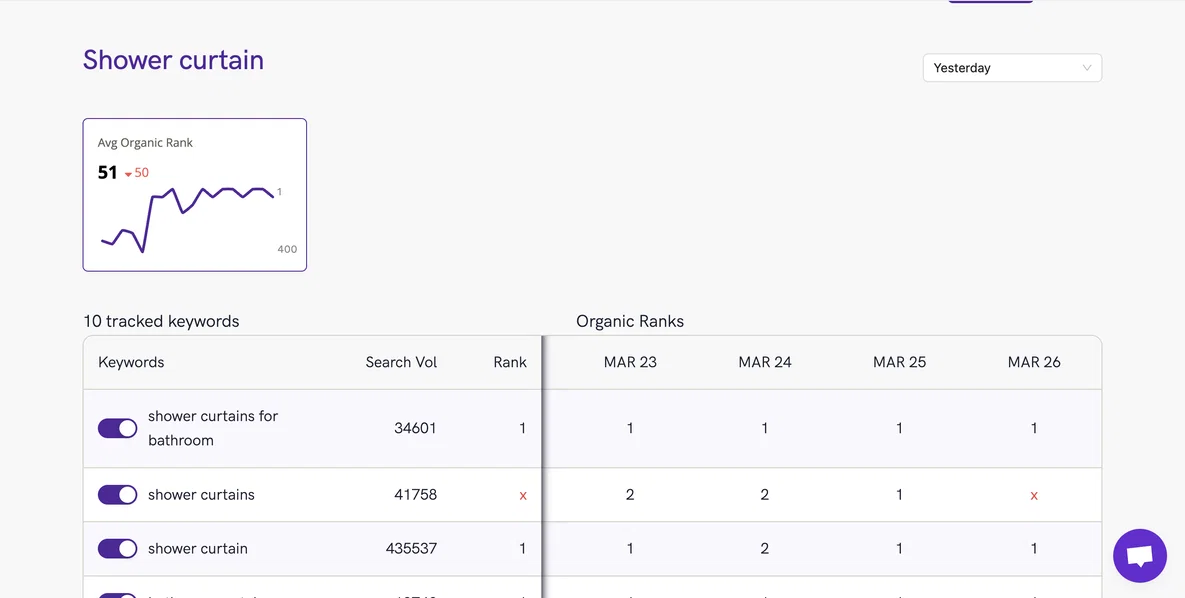
Every rank tracker answers "what moved." Perci is built to also answer "what do we do about it," in the same tool.
How to pick a rank tracking tool (or plan)
| Question | What to look for |
|---|---|
| How many keywords per listing? | Enough for real coverage (50 per ASIN is the target), not just the head terms |
| How often does it check? | Daily or weekly. Weekly is enough for category movement; daily adds noise. |
| Does it separate meaningful change from noise? | Alerts on significant movement, not single-position wobble |
| Can I see the catalog, not just one listing? | Catalog-level reporting across the tracked set |
| What happens after the alert? | Can you fix the listing in the same workflow, or are you handed a problem and a separate tool? |
| What does it cost per keyword? | Compare plans by price per tracked keyword, not headline price |
Frequently asked questions
Can I see my Amazon keyword rankings in Seller Central?
No. Amazon reports impressions, clicks, and conversions, but not your organic position for a keyword over time. That requires a rank tracking tool.
What is the difference between a rank tracker and SQP?
SQP shows what shoppers searched and did on your listing (impressions, clicks, purchases) aggregated over a period. A rank tracker shows your position for each keyword, point-in-time per check. SQP shows opportunities; rank tracking shows movement.
How many keywords should I track per listing?
If you can track everything, track everything. Perci automatically tracks the top 35 keywords per ASIN, which gives you real coverage of your keyword performance including the middle of the catalog, and it is possible because Perci's tracking plans are the cheapest in the market. If your allowance only covers ten, choose carefully: your conversion keywords and highest-volume relevant terms first. And avoid tracking keywords you will never rank for, like a broad, meaningless term that is practically impossible to win.
How often should rank be checked?
Weekly is the standard cadence. It is frequent enough to catch meaningful declines and stable enough to avoid noise.
What should I do when a keyword rank drops?
Diagnose before acting: check competitors, recent listing changes, whether the listing lost attributes, and price or review changes. Fix the cause, then re-measure over two to four weeks.
How is Perci's rank tracking different from a standalone tracker?
The tracking is comparable. The difference is what happens next: the listing that dropped is already in the workflow that rewrites and republishes it, so finding the problem and fixing it are part of one loop instead of two tools.